A UK maker puts a Gallic war chariot into circulation — 28mm, unbranded, unpainted, hand-finished. By the numbers it is a niche release. By the reaction it generated in miniature hobby communities, it was anything but.
That reaction is worth reading carefully: the audience for historical miniatures and the audience for fantasy miniatures are not two separate crowds. They overlap more than either side tends to admit — and a war chariot is a particularly clear example of why.
What a war chariot does at 28mm
A Gallic war chariot was not subtle. It was fast, loud, and built for psychological impact as much as physical damage. Ancient commanders used them to break formations before infantry contact — the noise alone could scatter unprepared troops. As an object of study in military history it is endlessly interesting. As a miniature at 28mm it brings that piece of ancient warfare down to a size you can hold, paint, and display.
That last point is what connects it to everything else on the collector's shelf. 28mm is not just a measurement — it is the shared language of the tabletop hobby. Figures at this scale work with the terrain, bases, and storage systems that most serious collectors already have in place. A new release at 28mm, whatever its subject, speaks directly to a community that already has the infrastructure to receive it.
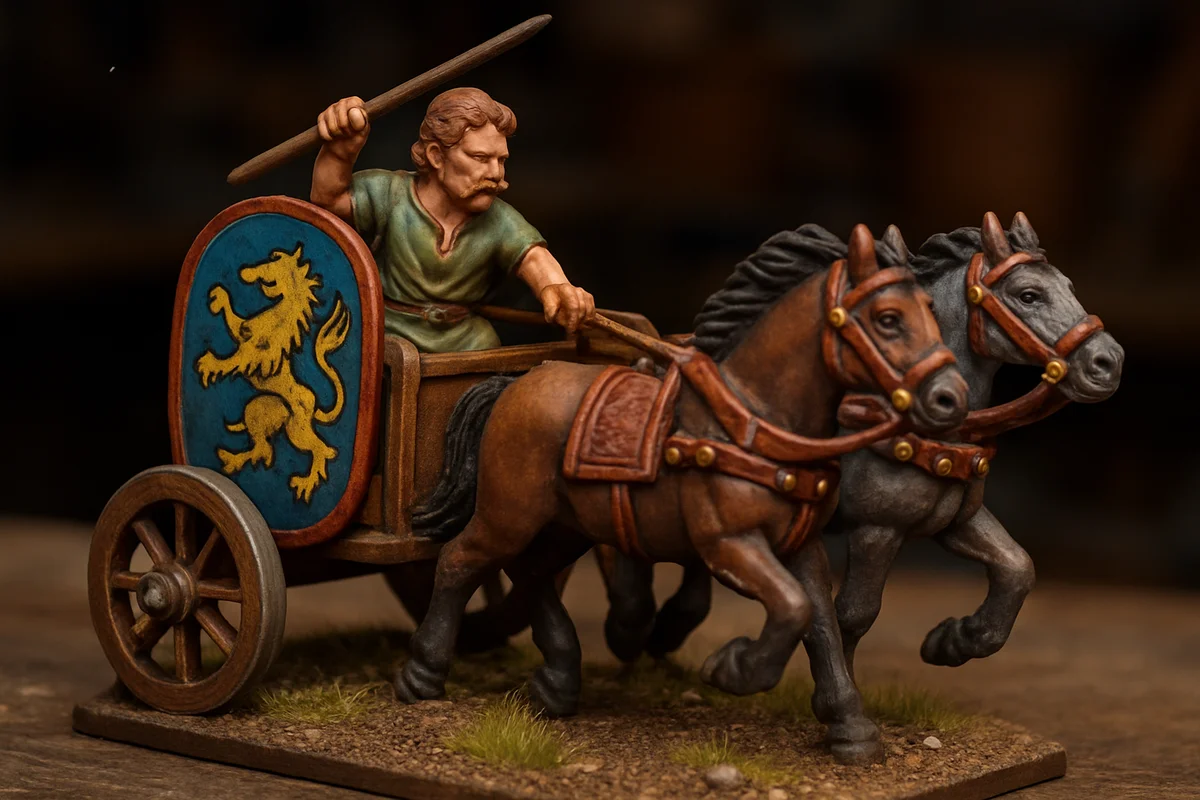
The war chariot adds a layer the single-character figure cannot offer: it is a unit with multiple components — the vehicle, the horses, the rider. That complexity rewards painters and modelers in ways a standing infantry figure does not. It also photographs well, which matters more than it used to now that collections move through Discord servers and social media.
The overlap with fantasy collecting
Here is what often surprises people: the collector who spends a weekend painting a Gallic war chariot is frequently the same person who has a dragon or a fantasy hero on the shelf beside it. The distinction between historical and fantasy miniatures is real at the level of research and period accuracy, but it dissolves entirely at the level of motivation.
Both satisfy the same need: they make a world — historical or fictional — physical. A miniature is an argument that something matters enough to exist in three dimensions. That is true of a Celtic chieftain and equally true of a Named hero from a fantasy universe. The collector who understands one already understands the other.
This is why independent makers producing universe-specific figures have found a ready audience among people who also track historical releases. Drakhthar, the epic fantasy universe behind this site, produces a line of FDM collectible miniatures — dragons and Named characters from its thirteen regions. They are not designed for tabletop combat. They are display pieces for readers who want something physical from a world they have spent time in. But the people who find their way to those figures are often the same people who have already put a war chariot or a Roman legionary on their shelf. The collecting habit transfers.
Three questions before you buy
If you are new to historical miniatures, or thinking about crossing from one category to the other, these three questions cut through most of the noise:
Painted or unpainted? Unpainted figures — like this week's Gallic chariot — cost less and let you make them fully your own. Painted pieces cost more but are display-ready immediately. Neither choice is wrong; they serve different collectors.
What era, and what does it connect to? A Gallic war chariot connects to Celtic history, to Iron Age Europe, to the specific kind of military innovation that preceded Roman expansion. A fantasy figure connects to its universe's lore. Both are worth knowing before you buy — the figure carries that context with it on the shelf.
Who made it and how? FDM and artisan production — the same approach behind many indie fantasy figures — has opened the historical miniature market to small workshops that could not sustain a casting operation. A small UK maker producing hand-finished Gallic chariots is the historical equivalent of what independent fantasy publishers are doing with character figures: making the niche, obsessively detailed thing that mass production will not touch.
The two markets are more connected than their communities sometimes acknowledge. The week's war chariot is a small, well-made reminder of that.